
The Far Right in Switzerland covers every election to the National Council, the larger of the two chambers of parliament, since 1971. The question: how strong has the far right been in these elections, and where in the country?
The long line since 1971.
In the 2023 election the far right had 30.3% of the vote: 27.9% for the SVP, Switzerland’s largest party, and 2.4% for smaller far-right parties.
“Far right” is not my own judgement here. The page follows the PopuList, which classifies the SVP as far right, and counts the SVP from 1991, the first National Council election the PopuList covers. Before that the SVP was a conservative farmers’ and trades party.
For the earlier elections the page follows the historian Damir Skenderovic and counts the parties of the movement against “overforeignization”: the Nationale Aktion and James Schwarzenbach’s Republikaner. They had 7.5% in 1971, their best result before 1991. The SVP had 11.1% in that election and is not counted.
Hence, the 7.5% of 1971 and the 30.3% of 2023 do not count the same parties and must not be compared directly. The comparison that holds starts in 1991, when the far right had 17.7%.
Reading the dot chart.
The main chart has one dot per canton for each election, and Switzerland as a line. The SVP’s results before 1991 are a dotted line and are not added in.
A dot is hollow where no far-right list or candidate stood in that canton, so its 0 says nothing about how people voted.
Cantons with a single seat elect by majority vote and the others by party list. In a single-seat canton the share is the vote for a person, which the Federal Statistical Office counts for that person’s party. One party can therefore look overwhelming there, as in the highest dot in the chart, Nidwalden in 2015 with 82.8%.
Where the far right is strong.
For each election the page has a map by canton and a zoomable one by commune (municipality), both hatched where no far-right list or candidate stood.
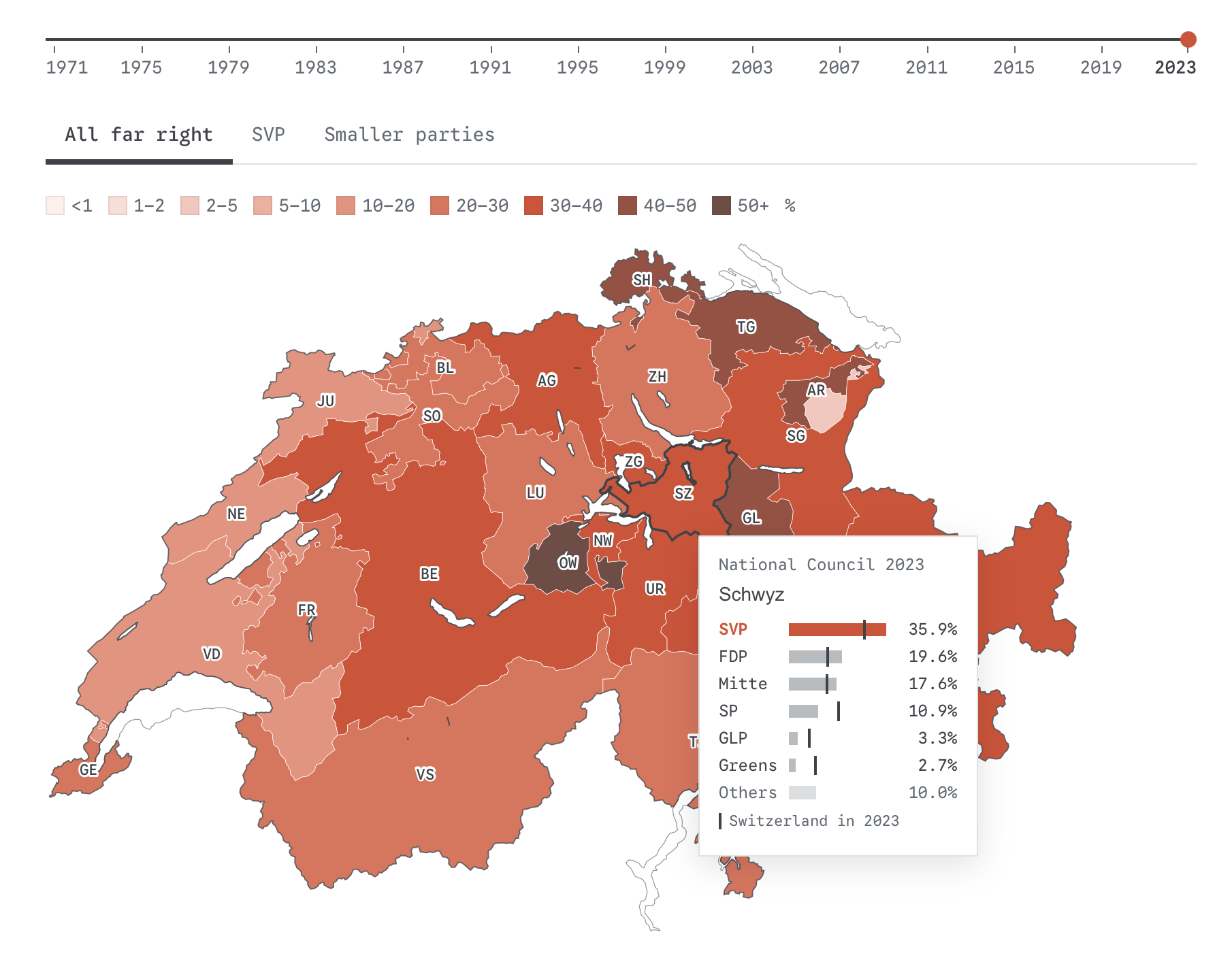
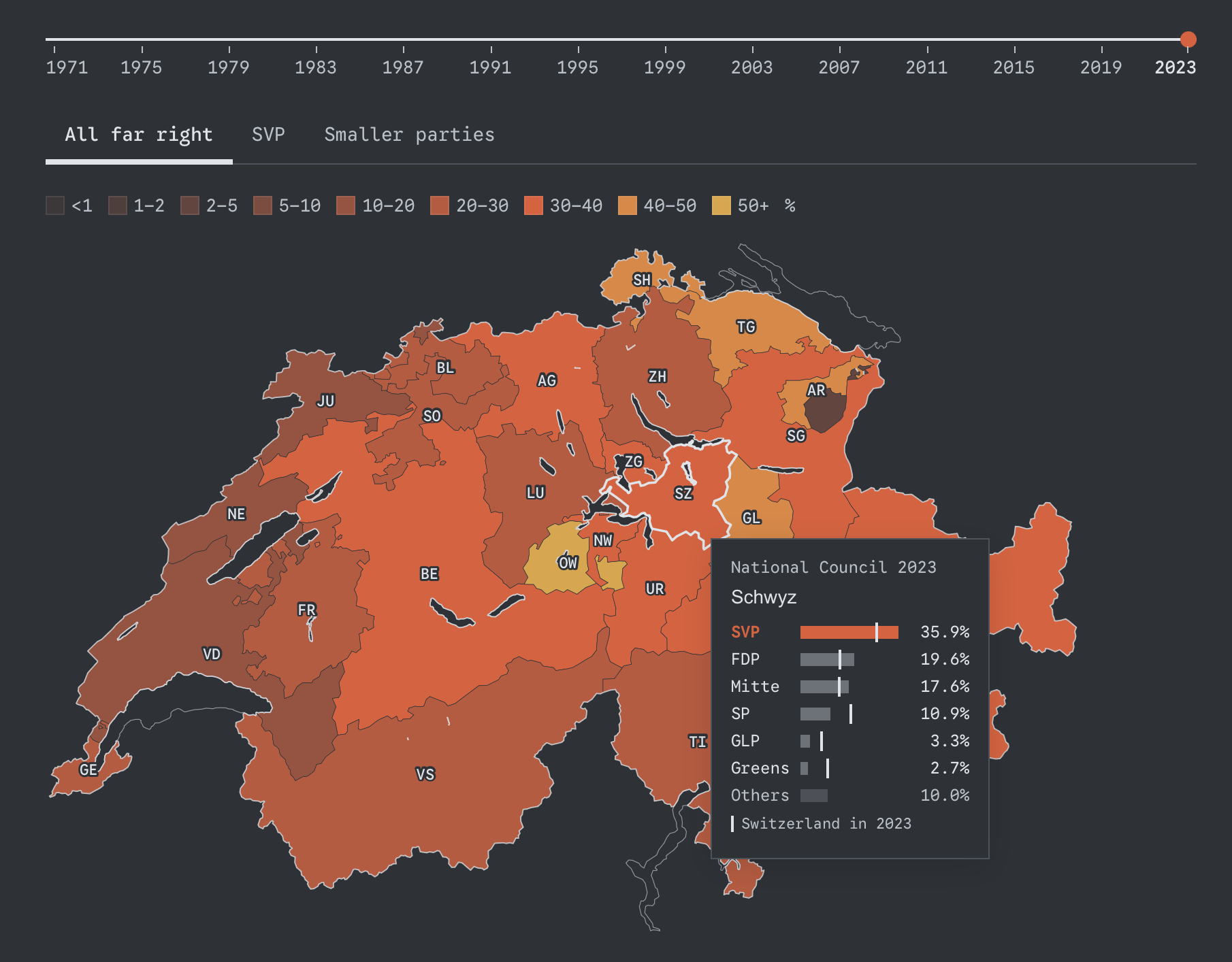 The canton map of The Far Right in Switzerland for the 2023 election, all far-right parties. Selected: Schwyz, where the SVP had 35.9%. Data: Federal Statistical Office.
The far right is much stronger in German-speaking Switzerland than in the French- and Italian-speaking parts. In 2023 it had 50% or more of the vote in 328 of the country’s 2,105 communes. Among communes with at least 100 voters, the highest share was in Schangnau (BE), with 83.2%.
What goes with it.
Here the page sets each commune’s far-right share next to seven commune measures and gives rank correlations, which compare how the communes rank on the share and on a measure. The two language regions are kept apart, because a single comparison would mostly show the gap between them.
In 2023, in both language regions the far right did best where many people work in farming and few people live per square kilometre, and where few foreign nationals live. For farming the rank correlation in German-speaking communes is +0.47: the larger the share of jobs in farming and forestry, the higher the far-right share tended to be.
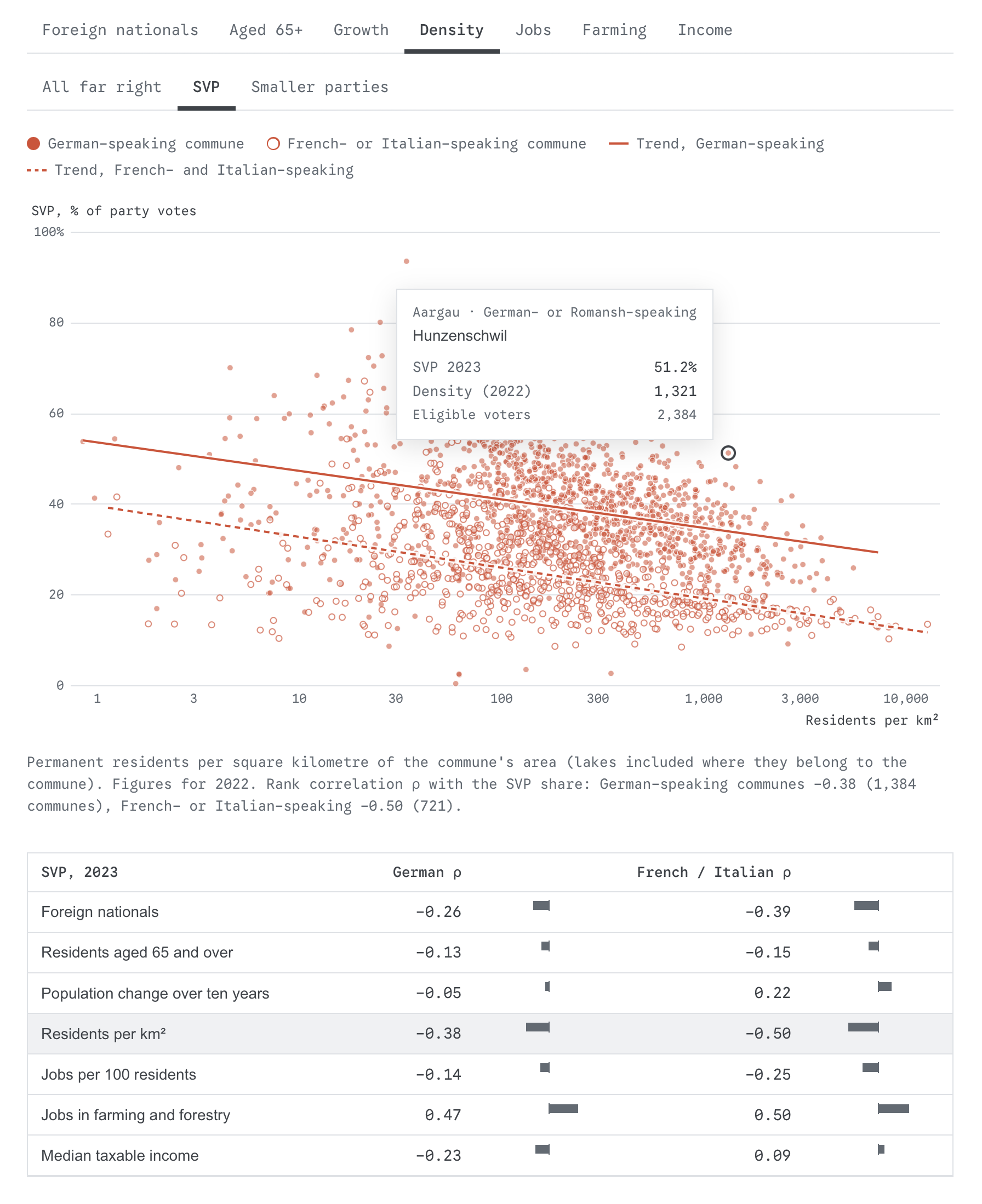
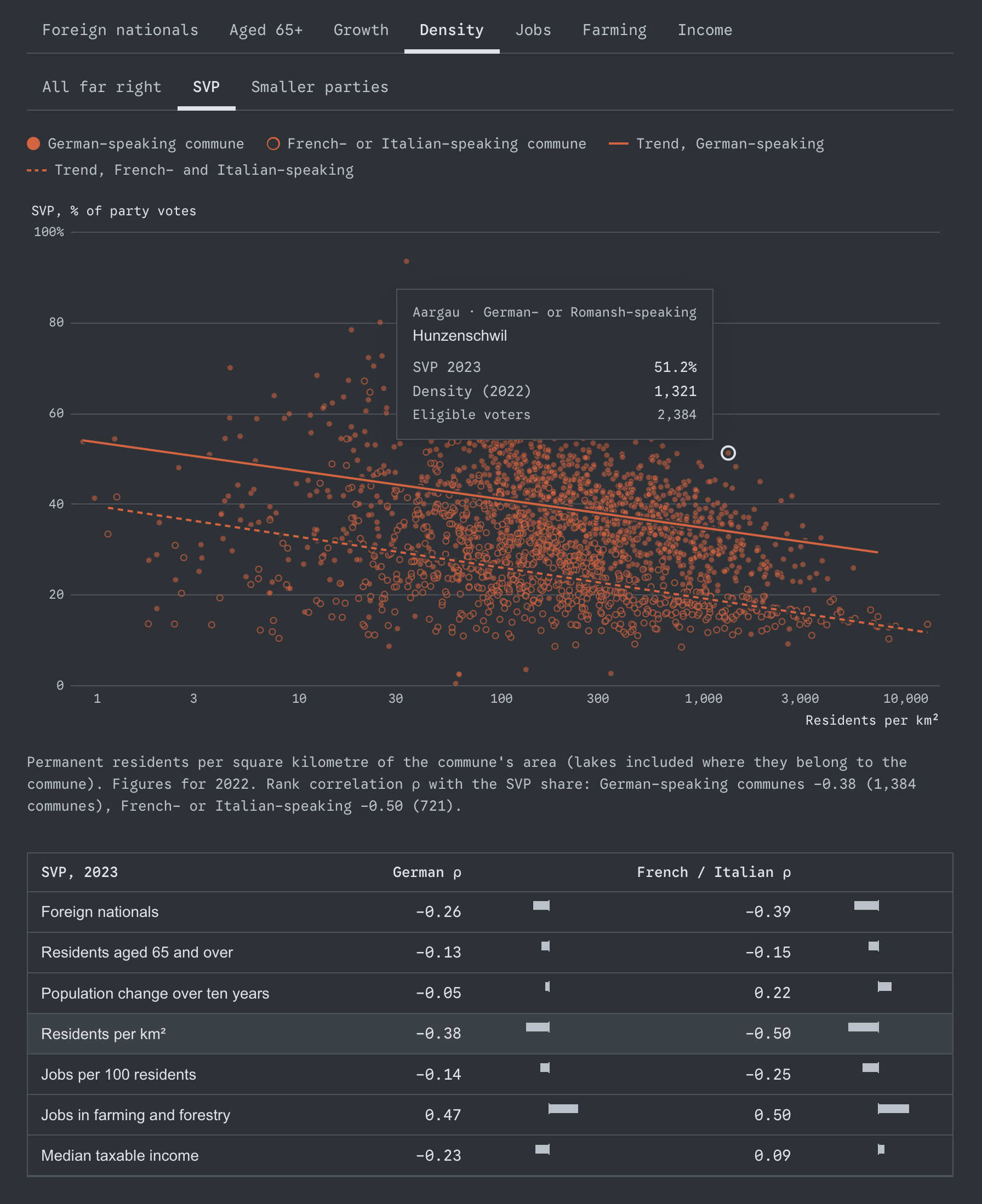 “What goes with it” with the SVP and population density selected: the denser the commune, the lower the SVP share tended to be in 2023 (rank correlation −0.38 in German-speaking communes, −0.50 in French- and Italian-speaking ones). Selected: Hunzenschwil (AG), SVP 51.2%. Data: Federal Statistical Office.
These are patterns across communes, not causes, and they say nothing about how any one person votes.
The data and their updates.
Again, the question and the rules were mine, above all to work with official data and not with personal data projects. An AI agent (Claude) loaded the data into my cloud database of choice (MotherDuck) and built the checks and the page. Every night the data are loaded again, and the page’s statements on what goes with the vote are checked against the latest election. If a check fails, the run stops before exporting and the page keeps the last good data.
The Far Right in Switzerland is part of the Swiss Democracy Lab.
If you spot a mistake, or a flaw in how the page reads the data, I would like to hear about it.